Paris, 1968
The girl stood on a bridge over the Seine, her heart broken by her first love, an art student from Brittany who’d dumped her for a more experienced American au-pair.
There was no wish to throw herself into the water, like so many did every year – she was too numb for that. She just stood there, until a wind arose and tugged at the scarf loosely draped around her neck, then lifted it away. It caught the current of air for a while, then drifted down to the river below and out of sight. If it didn’t drown, she thought, it would be found by someone walking on the bank or just float on through the city then north and into the English Channel hundreds of miles away.
I see it still, that scarf – long and chiffon, with a delicate leafy pattern, bought at Liberty of London.
Most of my scarves since then have led less adventurous lives, folded and stored in baskets or drawers or hung on a hook, ready to wear – but wherever it finds itself, the scarf has been a constant thread in my life, a lasting love affair.
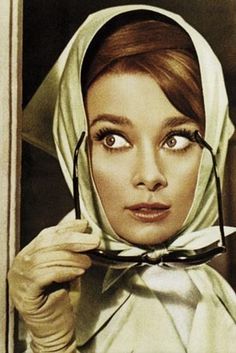
It is a truth not generally recognised that in matters of dress, people fall into two camps, those who love scarves and those indifferent or averse to them. I’ve lost count of my collection, organised by weight, colour, size or season, in cotton, cashmere, polyester, silk or wool. There must be over 80…. but in the great scheme of scarves, that’s nothing. The empress Josephine had over 400, exotic gifts from Napoleon brought back to France from Egypt and other conquered lands.
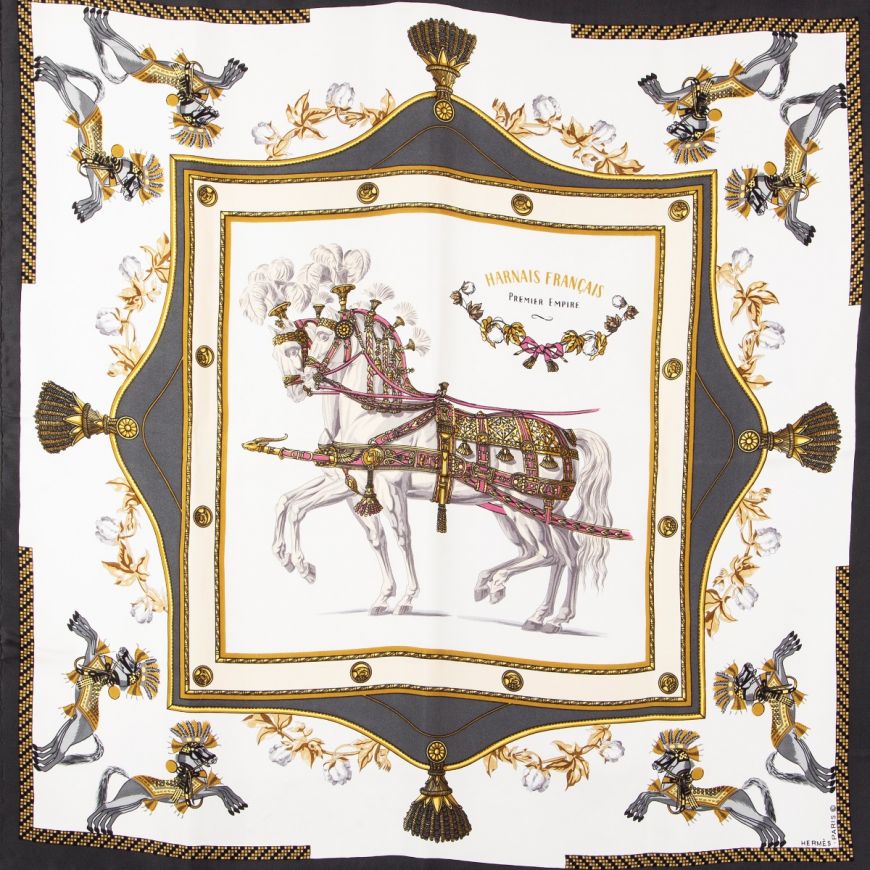
They say her late Majesty had quite a few, favouring the equestrian designs of the House of Hermès. Unlike a helmet, a headscarf wouldn’t flatten one’s hair when out riding… Other royal scarves served rather higher purposes, like The Queen’s Scarf, awarded – like a medal – to brave soldiers in the Boer War, some made in crochet by Victoria herself, who stitched her initials into the wool.
The provenance and quality of the scarf will certainly signal the status and taste of its owner, but it remains an addition to the wardrobe, not an essential garment to cover the body – like a dress or a pair of trousers. But it’s not an idle addition and far more than a bit of frippery…. Whatever its incarnation – as pallium or pashmina, tippet or tie, stole or shawl – its raison d’être is to protect and adorn the head, neck and shoulders.
It’s there to keep a worker’s hair away from food or out of dangerous machinery or shield the throat from polluted air. When the cold and damp could trigger an attack, a friend with asthma finds that a scarf over her nose and mouth is a ‘lifesaver’…
It can also be a killer. The fate of two famous women sadly proves it – women killed by or because of their scarves. One was the American ‘mother of modern dance’ – Isadora Duncan, who died at 50 on the French Riviera in 1927. Not strangled by some murderous madman, but slain by a 6ft length of pink and white handpainted silk. She was riding in a racing car, her voluminous scarf streaming out behind her, when it got entangled in the back wheels and tightened,,, pulling her out of the vehicle and breaking her neck. What not to wear in an open-topped moving car…
And yet travel and neckwear are natural companions. The early aviators sat in open cockpits in leather jackets and scarves that could double up as cloths to clean their goggles. And in a modern aircraft, the decent-sized scarf can pretend to be an in-flight blanket, even a pillow. And later serve as a shield against the sun, or in a country with a strict dress code, as a cover-up in places of worship.
And here another, younger woman appears. A Kurdish girl called Mahsa, who died in Tehran last September while in the custody of the ‘morality police’, accused of wearing her hijab too loosely, in a way deemed unlawful by the state. In the ensuing uproar, the brave women of Iran removed their headscarves and uncovered their hair… Acts of defiance far more eloquent than the words on any banner or tee-shirt, in defence of one of the most fundamental of human rights: freedom of choice.
It is not my struggle, but one which invites a closer acquaintance with something central to so many as a way of life and yet at its simplest, a humble piece of fabric, an extra layer against the weather. Which is how it must have been thousands of years BC, in a world of advancing ice. When in some stone or wooden dwelling place, a hairy hand picked up a discarded strip of animal pelt, liked the feel of it and wrapped it round a Neolithic neck…
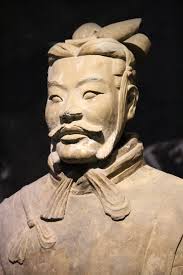
Fashion, ritual and belief were never far away. When an Iron Age body was revealed in a Danish bog, he was found to be wearing a scarf of checked material, with a fringe…. Several semi-circular scarves were found with Tutankhamun, while in another tomb in Ancient China, soldiers stood guard over their emperor, ready to fight for him in the underworld. The Terracotta Army – life-sized figures carved wearing scarves above their armour. Accessories not only for all seasons, but also for the after-life…
There were real soldiers once who starred in the story of the scarf itself – mercenaries from Eastern Europe who fought for the French in the 17th century. The neckerchief worn as part of their uniform was called a cravat, a corruption of Croat… The Sun King loved it, wore it in lace and silk and made it fashionable. And when it took on a narrower shape ending in a point, the modern tie was born.
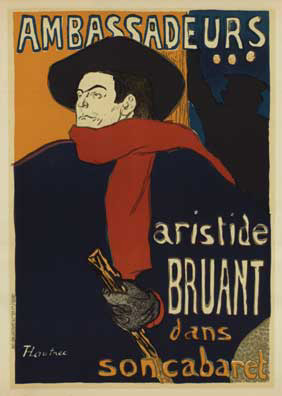
Such a cousin of the scarf still carries a correctness about it, an air of formality requiring the challenge of a knot… and an artist friend of mine wouldn’t be seen dead in one, preferring a less fiddly affair. He’ll toss a scarf over one shoulder or wind it once around his neck, leaving the ends to hang over his coat. However he wears it, it’s still rather long… His wife, who isn’t a scarf person, finds this admittedly rather studied nonchalance a bit embarassing. ‘He seems to think he’s Dr Who!’
I think he’s channelling the cabaret singer in a Toulouse-Lautrec poster, the scarf a link to a younger, single, bohemian self – but don’t tell her that.
As an item of dress – common to all cultures – the scarf’s popularity is permanent, sharing the world’s ever-basic shapes – the square, the triangle, the rectangle. And sometimes, in a form called The Infinity, a loop without ends, the circle. Comforter, concealer, globe-trotter’s friend – with a wondrous ability to transform an outfit in an instant and add to the gaiety of life. Something you can style – play with – in a any number of ways. A fold here, a twist there…
But the true lover of the scarf knows it’s best worn in a way befitting its simple and separate nature. In a way that allows the material to move with the wearer and reveal its pattern, the ends hanging freely and loosely enough to tempt the wind….
If you have enjoyed this post, you might also like no 17 (The Uniform) and nos 50 and 51 (The Shoe and The Eternity Ring)….
 Pensionista
Love this. So interesting and informative. Remember well that horrific scene in the Isadora Duncan film starring Vanessa Redgrave.
LikeLike
What a lovely description of a multi-purposed item. Plus, I learned a lot about those who also have worn the sometimes decorative and other times protective, and maybe comforting scarf. Thank you!!
LikeLike
Once again such imaginative writing.
I would never have believed that a beautiful ,lost chiffon scarf could lead to a delightful narrative on the complex history of scarves.
Well done and thank you.
Elaina
LikeLike
Hi Tess
A really interesting and well crafted piece of writing, as always.
The opening creates a vivid picture of the scarf being carried away by the Seine. I love the way the last paragraph brings the reader back to the Seine and the scarf whose ‘ends hang loosely enough to tempt the wind’.
It was fascinating to find out about different types of scarves and their uses. The interesting, the serious, the historical and the humorous are so skilfully combined. One moment I am feeling such sadness that a woman could meet her death simply because of wearing her hijab too loosely and the next moment I am smiling at a wife saying of her husband that ‘he seems to think he’s Dr Who!’
Thanks, Tess, for another wonderful read.
Sue. x
Sent from my iPad
>
LikeLike
From one scarf wearer to another, thank you…
LikeLike