The Viewing, Enfield, the northernmost borough of London. August, 2024
It wasn’t love at first sight – I’d grown out of that kind of thing anyway. But before following the agent out of the property, my hand reached out as if of its own accord and touched the sitting room wall, my fingers finding a cool, slightly uneven surface…..
It was a year since I’d sold my three-bedroom semi in the Midlands and returned to the capital, to stay in a friend’s spare room while I looked for a new place of my own. I’d lost count of all the properties seen since then. Road after road, house after house, door after door….
A mission that for a weary pensioner on her own and a limited budget had begun to seem impossible. Moving north to south, where you pay so much more for much less space, was never going to be easy; I’d be downsizing to a suitable shed or reasonable rabbit hutch, but it was time to return to the only roots that ever grew deep. To come home.
Like most people old enough to remember rationing, my attitude to money is conservative; I’m a natural squirrel, savings my security. Then my younger son, who lives in the borough, opened up a Conversation. He would help me with one of the most detested of taxes – Stamp Duty – but, ‘this IS a Rainy Day, Mum!’ So I smashed the piggy bank, which expanded the budget and brought some nicer places just within reach. My requirements, after all, were modest. A second bedroom and some outside space were non-negotiable, but no need for a garage or school nearby…
Which led to an address not set in a street at all, but in the oldest green space in the area: Chase Side, the remnant of an old hunting ground, itself a descendant of the ancient forest of Middlesex.
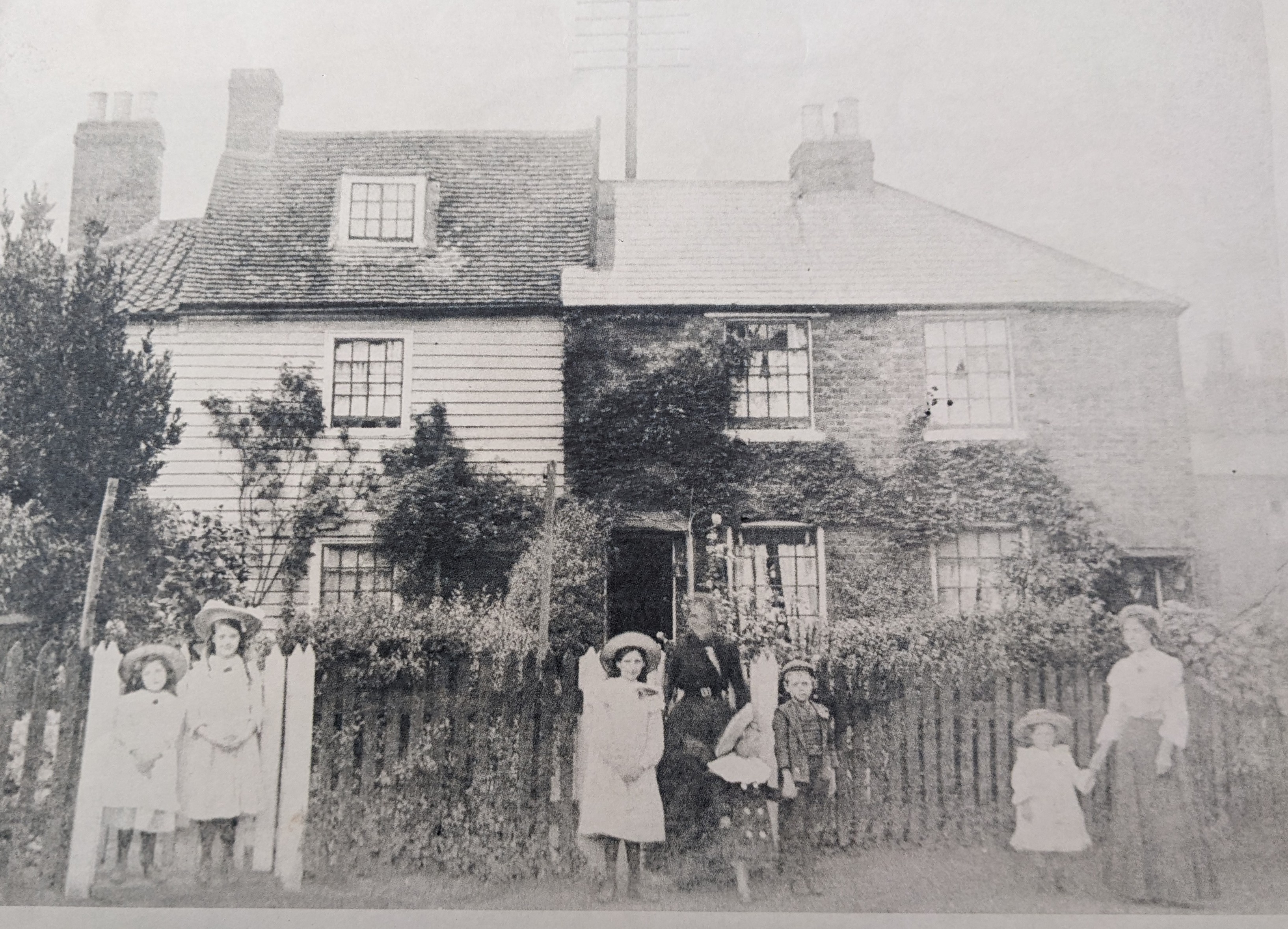
It was one of a row of terraced cottages, with a front garden facing south and bounded by a white picket fence. An unwinding path beyond the garden gate led to a patio; an enclosed, pocket-sized porch opened into a single space that stretched the full length of the lower floor. There were two modern extensions: a compact kitchen and a downstairs loo. Behind the building, a private alleyway – no back door, no back garden. The facade was weather-boarded, the casement windows in need of repair, the roof steeply pitched, while the chimney stack had a decidedly tipsy tilt…
The Sales Particulars described it as ‘ a period property, full of charm and character… in a desirable conservation area.’ Rather liked the ‘desirable’ bit.
The Survey would say that the part timber-framed building was ‘structurally sound’ if fragile in places – like me! The stairs creaked, like one of my knees, but I’m fond of stairs – all that going up and down, so directional – so it was never going to be a bungalow and didn’t fancy a flat or etirement complex or anywhere gated or ‘sheltered’…
The property was certainly small as any house calling itself a cottage had to be, but it was far from poky. Tardis-like, it was bigger on the inside than you’d ever imagine from the outside. There was also a ‘good storage opportunity’: an attic.
So we put in an offer way below the asking price which was accepted…perhaps because a previous sale had fallen through and the vendors were keen to move on. A friend, who believes in fate, was unsurprised: ‘this one,’ she said,’ was waiting for you!’ The process of purchase was a much slower affair and it wasn’t till the November that I collected the keys to The Cottage and opened the front door.
My furniture was still in storage – no chairs, no stools, no sofa – so I lay down on the carpet and let the tiredness take over, while my thoughts ran free in a space that would never be that empty again.
What lay beneath? In the days before modern concrete, the foundations would have been made of wood, stone and lime sunk into the heavy clay of the London basin, once itself the floor of the sea. No one knows when The Cottage was first built. One source says it was the 1600s with the construction of the New River nearby, which brought fresh water into the city from springs in the surrounding countryside. Another says the 1ate 1700s, in Georgian times, but documentary evidence is elusive.
The slightly sloping ceiling was crossed by a wooden beam, painted black. A square hollow in the wall was once a hearth, but centuries since a fire had been lit… Just lay there for a long time – a reverie interrupted by a soft thud in the porch. The delivery of a bundle of letters with my name on them, the first to this address.
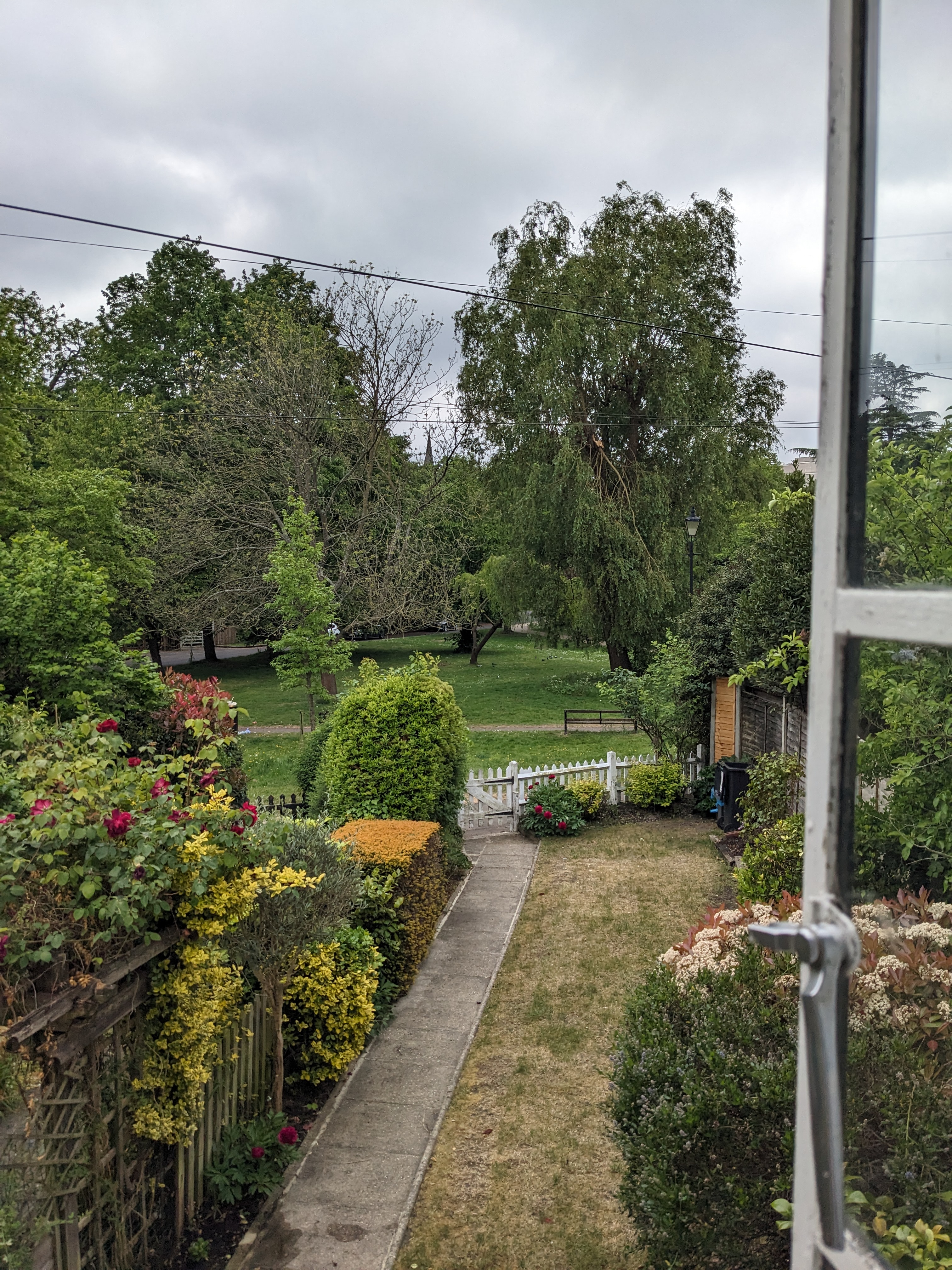
It was time to follow the carpet up the stairs to the landing, the little bathroom and two bedrooms. The one that faced the front garden was a Room with a View – not just a pleasing prospect, but an open sweep of a scene, with a roof-line in the distance far lower than the surrounding trees, broken by a single church spire. And in the tradition of landscape painting, a glimpse of human habitation on the horizon. The park beyond the picket fence was home to ducks and geese and a lake – a place perfect for a town mouse fond of the country.
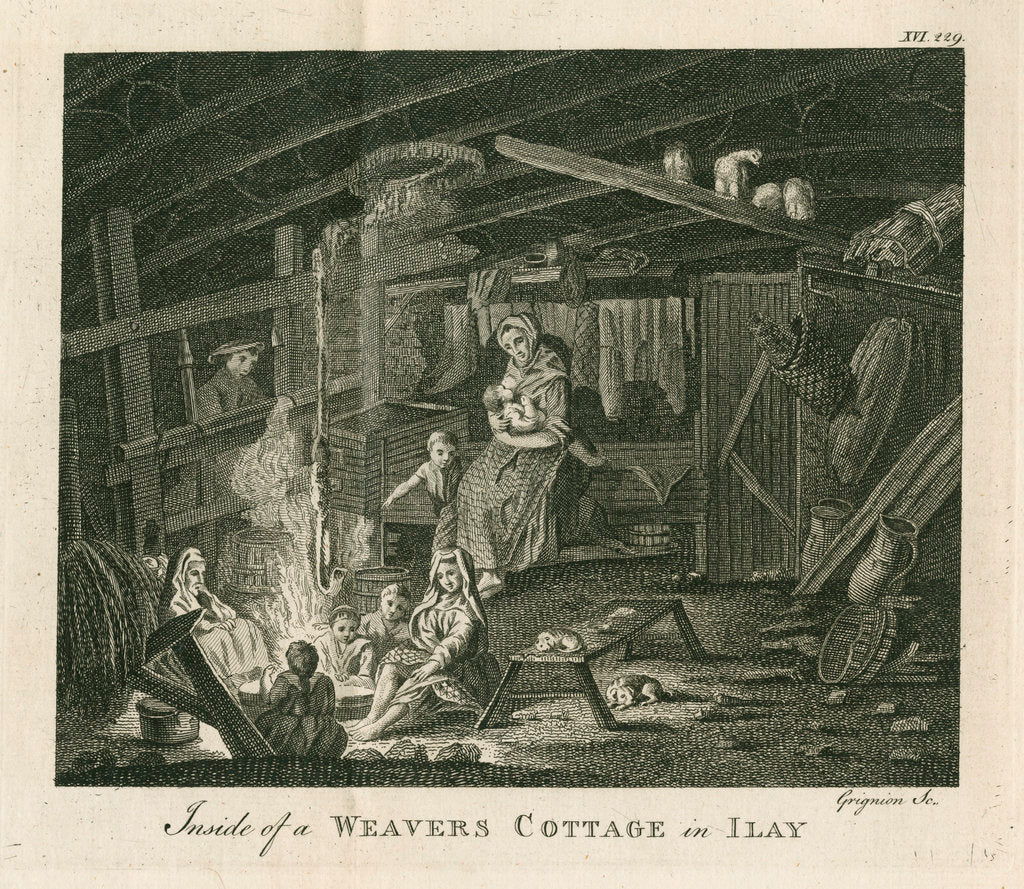
For the people who lived in these parts long ago, some in this very dwelling, the view would have been very different, but not the lie of the land itself, because my huddle of cottages was never part of some larger urban development like the terraces built by mine owners to house a growing workforce. Or weavers’ workshops, when working from home was the natural order of things. The cotters who came before me were probably labourers, farmers, foresters or keepers of the game that once roamed freely on the Chase, employed by the local gentry.
If the inhabitants of The Cottage were the poorest sort, it was a home made of the meanest materials like wattle and daub, supported by timber. A single smoky chamber was shared with animals like pigs or cattle, sources of warmth as well as food. The only light after dark came from the fire in the hearth or tallow candles, while the ground floor was literally that – made of beaten earth. A home in which they were born, lived and often died too young.
I rather like the idea of a pig or an cow crossing the same threshold, but The Cottage, however humble its origins, may well have had space outside enough for a sty, hen coop or even a bee-hive. A hard but relatively free life, tenants enjoying the traditional rights of fishing and forage, the grazing of livestock and gathering of firewood – until the Acts of Enclosure in the 18th century turned common land into private property. Then the fences went up and hunting became poaching, forcing many cottagers into greater poverty or the slums of the city.
The romantic snob in me prefers to imagine a more settled state of affairs on the fringes of Polite Society, in a superior kind of cottage made of brick. With handmade rugs on a swept stone floor, a spinning wheel in the corner and an upper room or two.
But whatever the past condition of the building and the status of its occupants, indoor plumbing was a world away, proper drainage uncommon until mid-Victorian times. Water still came from a well or a pond or a pump and the privy was always outside.
So much of the material past has vanished – buried, forgotten or changed beyond recognition. The Cottage as a structure has itself evolved over time, which confers its own special weight in this world – it’s a survivor. There was a row of perfectly sound old cottages a few streets away that were demolished in the 1960s to make way for a ring road that was never built; the site is now a council car park. The Cottage, by some miracle, is still standing, still on the map.
Which allows me to share the long story of a historic little house with all the others who called it home: they were part of its past as I will also be. There’s the occasional glimpse of a recent predecessor, like the widow who lived here until her death, whose daughters sold me the property. Not long after moving in, I noticed a small round hole, edged in brown, near the hem of a voile curtain, which had a certain stale odour. So the lady was a smoker, who dropped a cigarette one day…
But unless a ghost in need of a gossip turns up to tell me tales of those who lived here under this roof much longer ago – a crime of passion, perhaps, the heroic mother of ten or the deranged soul confined to the attic – I’ll never know their names or what their lives were really like. The records of past ownership are very sparse, though a local archivist did find me an undated copy of an old photograph. And yet the mystery that adheres to The Cottage is in a way, its mistress – and the very absence of information may set the imagination free to travel and play….
The cottage as a home, idea and symbol has its own history, deeply rooted in the language. The words ‘cottage’ and ‘cot’ have common Germanic roots – ‘cot’ meaning a small bed or humble hut, bigger than a cabin, more solid than a shack. a shelter from the storm or forces beyond our control.
The little house is a recurrent feature in folklore and fairy tales of the 18th and 19th centuries, but with themes deep in the ancestral memory, like plague or famine or fear of the unknown, symbolised by a forest, through which a path might or might not be found. Once upon a time….
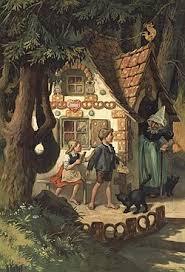
…two children were abandoned in the woods by parents who couldn’t afford to feed them. Lost and hungry, they came across a little house made of gingerbread, with windows of clear sugar. While in another forest, a girl in a red cloak set off to her grandmother’s cottage, but met a hairy stranger on the way… My favourite fairy tales as a child, when I often felt scared and lost myself: Hansel and Gretel and Little Red Riding Hood. Where the cottage is both sanctuary and place of danger, in stories that also speak of survival and the transforming power of love…
In another account, the cottage is more closely a ‘character’ in itself, although its regular proportions made it ‘defective’ and there were four bedrooms, so hardly a hovel. In the novel By a Lady, published un 1811, a mother and daughters in reduced circumstances fetch up in a cottage in Devon, but find themselves happier there than in the great estate they left behind. In Sense and Sensibility, a shallow and affected young man declares himself ‘excessively fond of a cottage….there is always so much elegance and comfort about them,’ though – unlike Jane Austen herself, he had never actually lived in one.
It was at this period, the late 18th and early 19th centuries, that the cult of the cottage reached its height as part of the picturesque movement, which saw landscape like a picture in a frame and celebrated the romance of ruins and the untamed beauties of nature. It’s how the View was born.
For the upper classes assured in their estates and for queens in their parks and palaces, the pastoral scene and dwelling place became symbols of a more informal way of life. In 1772, an ornate style of cottage was built at Kew for Queen Charlotte, the consort of George III, which came with its own menagerie, including kangaroos. While in France, a decade later, her penfriend Marie Antoinette created her own rustic retreat: a model village with a working farm and dairy, where the cottages had thatched roofs but a sumptuous decor inside, one with a ballroom. A place where she and her intimate circle could dress down and pretend to be shepherds or milkmaids. A world of make-believe, when less than a league away was a real village where commoners lived in cramped and desperate conditions…
To endure, an idea requires an image to bring it to life and so free it to travel beyond the mind. Artists like John Constable painted cottages in cornfields and on riverbanks, under bright, shifting skies , while van Gogh’s subjects were rougher, more ramshackle structures set in semi-darkness at the end of the day.
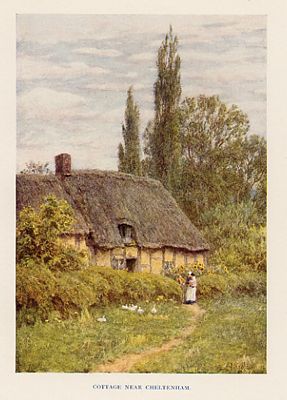
It was the work, however, of an under-rated artist, Vincent’s contemporary, whose watercolours established the popular image of the cottage set in a simpler past. Helen Allingham, (1848 -1926). This is the cottage down a country lane, roses rambling round the door, a woman or child in bonnet and apron at the gate, awaiting the return of a picturesque peasant – in smock and straw hat – from a hard day’s work in the fields nearby. Scenes with no shadows. It was a world fast disappearing, many of the buildings she depicted now demolished.
The cottage, then, has multiple but enduring identities: a humble home or romantic retreat, painters’ pet subject, literary character, idyllic icon of the Simple Life. And a sign for our times too – designers’ darling…
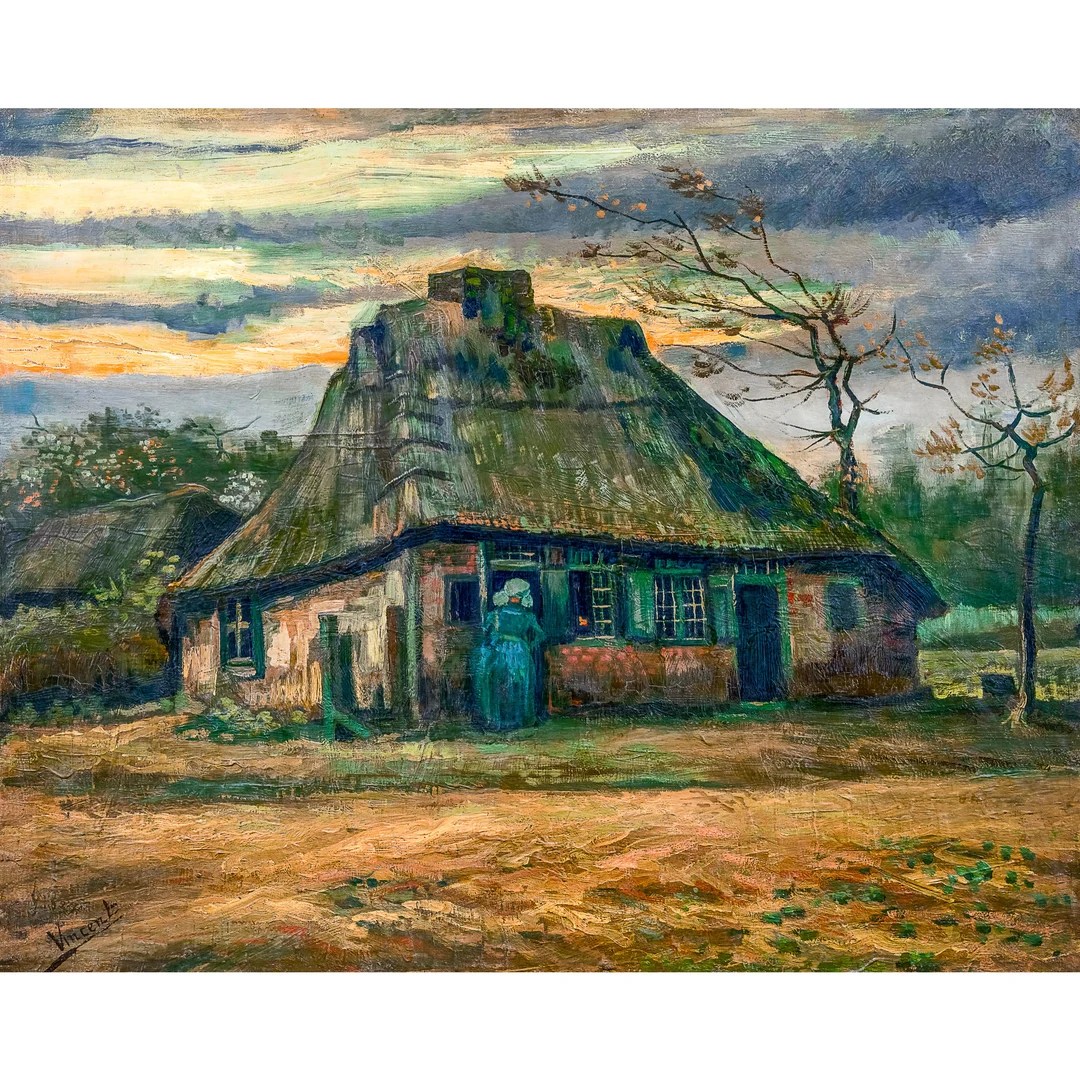
Because now the cottage has a ‘movement’ all of its own. A trend on social media that took hold in the Covid years, when a people in lockdown had to focus on their immediate environment. An aesthetic that espouses the ethics of thrift and sustainability and involves a lot of home-baking and handicraft, eco-friendly fashion and allotments.
Labels like ‘heritage’ and ‘traditional’ shift a lot of merchandise, but the movement is rather more than a nostalgic sigh for slower times, the old simplicities and the craftsmanship common in the days before mass production. In a digital age of instant purchase and ‘connection’, when people live surrounded by bland and shiny surfaces, a hunger grows for textures more compatible with the skin. For the more individual, maybe imperfect item which will fall into graceful decay, as the human being hopes to do.
I’ll never knit my own scarves or make my own decorations or grow my own cabbages, but I’m a natural cottage-corer all the same; a lifelong attachment of tea-lights, baskets and herbal remedies proves it.
I was even going to call myself a cottager, until a gay friend mentioned its associations with ‘cottaging’ – sex with strangers in public toilets, which was never my style – and still illegal. The first such conveniences, in Victorian times, were apparently sited in buildings resembling cottages…
So now our cottage has a criminal side to its character… But the hero of this piece is the conventional kind, the one still to be found down a village street or a row of cottages surviving in the city…and the cousin to countless others on the vast plains of literature, from a little house on a prairie to a burrow dug into a hill in Middle Earth.
There are other buildings forever rooted in the collective consciousness and ancestral memory, in a way the identikit box or high-rise tower faced with glass can never be. The inn and the manor, the castle and the cathedral, the stately pile and the palace. But it’s the smaller structure, built on a more human, relatable scale and at peace with its surroundings that seems to have an abiding hold on the heart. Perhaps because it speaks to us of deep home; it’s the cave that came into the open.
I’m only the latest in a long line of caretakers of The Cottage and find a real comfort in the continuity of tenure. And like the widow, I live alone – not through choice, just the way things worked out. But I don’t feel isolated, because The Cottage is embedded not only in the landscape but in the community and my neighbours are Proper People. The spirit of the place is a kindred one.
I was a last-time buyer who found a happy ending – back close to my beginning. A way was found through the forest. I was able to turn the handle of the door that awaited the touch of my hand and accept the great gift that lay beyond it: somewhere new to love.


I loved the story of your pretty cottage. You have written a wonderful history ,which includes the cottage plus so much information.
Your cottage looks just the right home for you , the cottage is so interesting,I find myself imagining who would have lived there , and how they lived.
The view from the window is so lovely, it must be easy to spend time just watching the scenery .
LikeLike
Beautiful and interesting
LikeLike